To turn customer questions into useful website articles, collect recurring enquiries, group them by the decision people need to make, check whether your website already answers them and write the missing explanations. Add relevant evidence and a clear next step.
This creates a practical starting point for content planning. You are working from questions people have actually brought to the business, while still checking wider search needs and existing coverage before deciding what deserves a separate article.
A customer question is evidence that one person needed an answer. It is not, by itself, a measurement of how many people search for the phrase on Google.
Start with the conversations your business already has
Look at the questions people ask through permitted business enquiry channels, discovery calls and ordinary service conversations. Admissions teams, support staff and sales colleagues can help identify patterns.
Keep the useful question and relevant context. Remove names, telephone numbers, private documents and other details that the article does not need. Recording a topic for editorial planning is different from obtaining permission to publish an identifiable customer’s story.
A simple question log can contain the question, audience, service involved, frequency observed in your own records, existing answer, proposed destination and evidence needed. Keep observations separate from estimates.
A practical example from Mita School enquiries
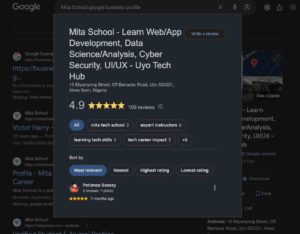
At Mita School, prospective learners ask about course fees, instalments, class schedules, laptop requirements, beginner suitability and what they can build during training. Those questions concern different decisions, even when they arrive in the same message.
For planning purposes, a laptop question can inform a requirements guide. A fee question belongs first on the current programme or admissions information. A question about practical work can lead to an explanation supported by an attributable project.
This example shows how to organise enquiries. It does not establish keyword volumes, ranking positions or student employment outcomes.
1. Identify the decision behind the wording
Two people may phrase the same need differently. “Can I pay gradually?” and “Do you accept instalments?” can often be answered together. Separate articles for every wording variation would make the website harder to maintain.
Other questions sound similar but require different explanations. “What does the website cost?” concerns scope and price. “What will maintenance cost?” concerns ongoing responsibilities and recurring charges.
| Question type | Reader decision | Likely destination |
|---|---|---|
| What do you offer and who is it for? | Whether the service fits | Service or programme page |
| How does this process work? | How to prepare or proceed | Practical guide |
| Which option should I choose? | How to compare alternatives | Comparison with clear criteria |
| Have you done relevant work? | Whether your experience is applicable | Specific project or case study |
| Where do I apply or enquire? | How to take action | Application or contact destination |
2. Check whether the answer already exists
Review your service pages, FAQs, guides and projects before creating another article. If a useful answer already exists, improve its clarity, completeness or discoverability.
A short question may deserve an FAQ on the relevant page. A decision involving several trade-offs may justify a substantial guide. A case study needs a real project and enough evidence to describe the contribution accurately.
For example, my existing guide on school websites and school management systems already addresses that comparison. Another title with slightly different wording would need a distinct reader purpose to justify a new page.
3. Research the wider question without inventing demand
Search the main question and examine relevant results. Record the date, location context and the kinds of answers readers encounter. Look for gaps in clarity, evidence, practical detail or relevance to your audience.
Where available, use your own search performance data to understand the queries bringing people to existing pages. Keep those measured queries separate from suggested keywords and editorial hypotheses.
Do not label a topic “high volume” or “easy to rank” without an appropriate basis. Search results, customer conversations and keyword tools provide different kinds of evidence.
4. Write a title that matches a useful answer
A strong working title explains the question or task. Avoid adding a date, number or dramatic promise unless it serves the content.
- Question: Why is my business website not bringing enquiries?
- Preparation: How to prepare a website brief for your school.
- Comparison: School website versus school management system.
- Practical task: How to organise programme information for an event website.
These are editorial examples, not claims about measured search demand. Choose the final title after reviewing the intended audience, existing content and available evidence.
5. Answer directly, then explain the choices
Open with a clear answer and the main conditions that affect it. Build the rest of the article around what the reader needs to understand or do.
Useful sections may include a decision table, a worked example, a preparation checklist, common mistakes and focused follow-up questions. Use those elements because they help the explanation, rather than to meet a fixed article template.
Google Search Central encourages content that serves people and contributes useful information or experience. Its guidance does not specify a preferred article word count. Choose the length needed to answer the question well.
6. Match evidence to the claim
A service screenshot can show what a website presents. It does not establish that the website generated sales. A customer quotation can describe an individual experience; it does not automatically prove a broad business outcome.
For each case example, record the problem, your exact role, the delivered work, the source of any result and permission to use the material. If you have no suitable case, explain the method or use an explicitly hypothetical example.
The value of a case study comes from what it helps the reader understand and what the evidence can support.
My BIUC website case study is an example of project-specific context for a service discussion. Its service structure can support an explanation of information organisation without being presented as a quantified marketing result.
7. Give the article a place in the website
Link to the service or programme that answers the reader’s next commercial question. Link to a relevant case study when it provides supporting context. Use descriptive anchor text that tells readers what to expect.
Google Search Central recommends relevant, descriptive links and contextual internal linking. This supports useful navigation; it does not create a guarantee of rankings.
An article about preparing a website brief can lead to website development services. A content planning guide can lead to writing and content development or SEO strategy support. Those destinations serve different next steps.
8. Review what changes after publication
Keep a baseline where data is available. Review search impressions, visits, relevant onward clicks and actual enquiries separately. A useful article may also help staff answer recurring questions, but document that observation rather than assuming it.
Update operational details when they change. If several pages start answering the same question, review their contents and available query data before deciding whether to combine them.
A simple brief for your next article
- Who is asking, and what decision are they trying to make?
- What is the direct answer?
- Does a suitable page already exist?
- What source supports each material factual claim?
- What original experience or example can you contribute?
- Which related service, guide or project will help next?
- Who will check the draft, and what needs future review?
Frequently asked questions
Should every customer question become a blog post?
No. Some belong on service pages, in FAQs or in private replies. Create a separate article when the question needs a distinct and useful explanation.
Can AI help organise the question log?
Yes, with appropriate handling of customer information and human checks. Verify factual claims, avoid invented experience and make sure the finished answer serves the reader.
How many articles should we publish each week?
Choose a pace your team can research, review and maintain. Evidence and usefulness should determine readiness.
Research references, checked 3 November 2026: Google Search Central, helpful content and link best practices. Copyable references: developers.google.com/search/docs/fundamentals/creating-helpful-content and developers.google.com/search/docs/crawling-indexing/links-crawlable.
Discuss your website with me
I am Lawson Godwin Hezekiah, founder of Mita School and Techmita. Tell me what your organisation needs to improve, who the website serves and what visitors should be able to do. We can agree the scope, priorities and next steps.
- WhatsApp: Send me a message on WhatsApp.
- Contact form: Send a project enquiry through my contact page.
- Email: [email protected].
- Phone: +234 703 799 7791.
Based in Uyo, Akwa Ibom State, Nigeria. Remote project arrangements can be discussed.