To assess whether SEO is bringing business enquiries, connect three kinds of evidence: search performance, actions on the website and the enquiries your team actually receives. Report each stage separately before drawing a conclusion about business value.
A higher ranking or more visits may be useful progress, but neither establishes that suitable customers contacted the business. Equally, a telephone enquiry may have been influenced by the website even when no contact form was submitted.
Begin with clear definitions and a manageable reporting process. A small, consistent record is more useful than a dashboard full of numbers nobody can explain.
Define an enquiry before choosing a metric
Agree what counts as a relevant enquiry for your business. A useful definition might be a new person or organisation contacting you about a service you actually provide, with enough information for a reply.
Record spam, repeat messages and unsuitable requests separately. Define a qualified enquiry according to the actual buying requirements rather than assuming every message is a sales opportunity.
A completed sale, application or enrolment is another stage. Keep those outcomes distinct so that the report describes what happened.
Use a simple measurement chain
| Stage | Example evidence | What it tells you |
|---|---|---|
| Search visibility | Search Console impressions and relevant queries | Where the site is being shown in search |
| Website visits | Appropriate analytics reports | Recorded visits and their reported acquisition context |
| Contact actions | Tested form or contact-link events | Attempts to take a next step |
| Enquiries received | Inbox, form or call records | Actual contact reaching the business |
| Qualified opportunities | Reviewed enquiry records | Requests that fit the business’s definition |
| Business outcomes | Confirmed operational or sales records | The later result, where it can be established |
The stages do not automatically join into one complete record. Your reporting should state which connections are supported and which remain unknown.
1. Establish the starting position
Record a baseline before major changes where data is available. Include the dates, relevant pages, known campaigns and any seasonal factors. If tracking has only just begun, state that limitation.
Use complete and comparable periods. A short admission campaign, holiday period or large announcement may affect behaviour without reflecting the long-term performance of a service page.
Keep an implementation log: what changed, where and when. It helps explain the context without claiming that every later change was caused by one edit.
2. Review relevant search visibility
Google Search Console‘s Search results report provides clicks, impressions, click-through rate and average position, with ways to review pages, queries, devices and other dimensions.
Look at the pages and questions related to your actual services. Separate searches for your business name from broader service questions where the available data supports it.
Average position is a summary measure, not a fixed position every customer sees. Use it alongside clicks, impressions and the relevance of the queries.
A report should explain whether visibility is growing for useful topics, rather than celebrating an increase driven mainly by unrelated visitors.
3. Define and test website actions
Decide which interactions matter: a successful enquiry submission, an appointment request or a relevant contact-link click. Give each event a definition that the business and technical team can understand.
Google Analytics allows important interactions to be marked as key events after the relevant event is set up. The implementation and counting choices need to match what you intend to measure.
Test the event with authorisation. A click on a submit button should not automatically be treated as a successful form receipt if validation or delivery can fail.
Count the action your tracking actually observes. Use business records to establish what happened afterwards.
4. Distinguish WhatsApp clicks from messages
A visitor can open WhatsApp and decide not to send anything. Another may save a phone number and contact the business later. A contact click is therefore an intermediate signal.
A relevant starter message or an agreed enquiry-source question can provide context, but neither guarantees perfect attribution. Preserve unknown sources instead of forcing every conversation into a marketing category.
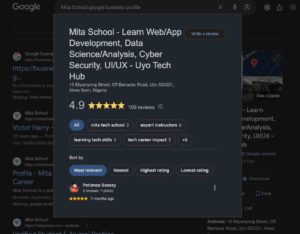
At Mita School, a question about course fees and a confirmed student registration represent different stages. The same distinction applies to service enquiries and completed client engagements.
5. Review the enquiries your team receives
Use a proportionate internal record of the date, service requested, available source context, qualification status and next step. Keep only the information needed for the agreed business purpose.
Decide how duplicates are handled. Several messages from the same prospect should not automatically become several new opportunities. Also explain how telephone and direct email enquiries are included.
The staff handling conversations should help define the process. A report that cannot be reconciled with their experience needs investigation.
A project-based measurement question
The BIUC website project connects specialist services with a contact route. A measurement brief for that kind of website could ask which service pages lead to relevant enquiries and how the business assesses those requests.
This is a proposed reporting question, not a statement of BIUC’s analytics, lead volume or sales results.
6. Understand why reports may differ
Search Console, website analytics and enquiry records measure different things. They can use different definitions and collection methods, so their totals should not be assumed to match.
Consent choices, browser behaviour, multiple devices and a customer’s route between channels can leave gaps. Attribution reports are useful models, but they do not observe every influence on a buying decision.
Explain those limits in ordinary language. It is better to report a supported trend and an unknown source category than to invent a complete customer journey.
What should a useful monthly report contain?
- The period, comparison period and important context.
- Relevant search visibility by useful page or topic.
- Recorded contact actions and their definitions.
- Actual and qualified enquiries where records support them.
- Confirmed later outcomes, with clear attribution limits.
- Work completed, observations and the next proposed actions.
Choose the reporting rhythm to suit the business. A monthly report is one practical option, not a rule that makes a small sample conclusive.
Use the findings to choose improvements
If useful search visibility is limited, investigate the relevant content and technical foundation. If suitable visitors arrive but rarely contact you, review the offer and enquiry journey. If enquiries arrive but stall, review qualification and response.
Different findings call for different work. My SEO services, content development, website care and consultation can be scoped around the actual evidence.
Frequently asked questions
Are more organic clicks proof of more leads?
No. Review contact actions and actual enquiries to understand the next stages.
Should every WhatsApp click be marked as a lead?
Define it as the action observed. A received, relevant conversation needs separate evidence.
Can every sale be attributed precisely to SEO?
Usually there are limits. Record what is supported and avoid assigning an unsupported source to every outcome.
Research checked 3 November 2026: Google Search Console, Search results performance (support.google.com/webmasters/answer/7576553), and Google Analytics, key events (support.google.com/analytics/answer/13128484).
Discuss your website or digital project
Send me your current website, the problem you want to solve and the people you need to serve. We can review the requirement and agree a practical scope, timing and quotation.
- WhatsApp: Start a conversation on WhatsApp.
- Contact page: Send a project enquiry.
- Email: [email protected].
- Phone: +234 703 799 7791.
Based in Uyo, Akwa Ibom State, Nigeria. Remote working arrangements can be discussed.