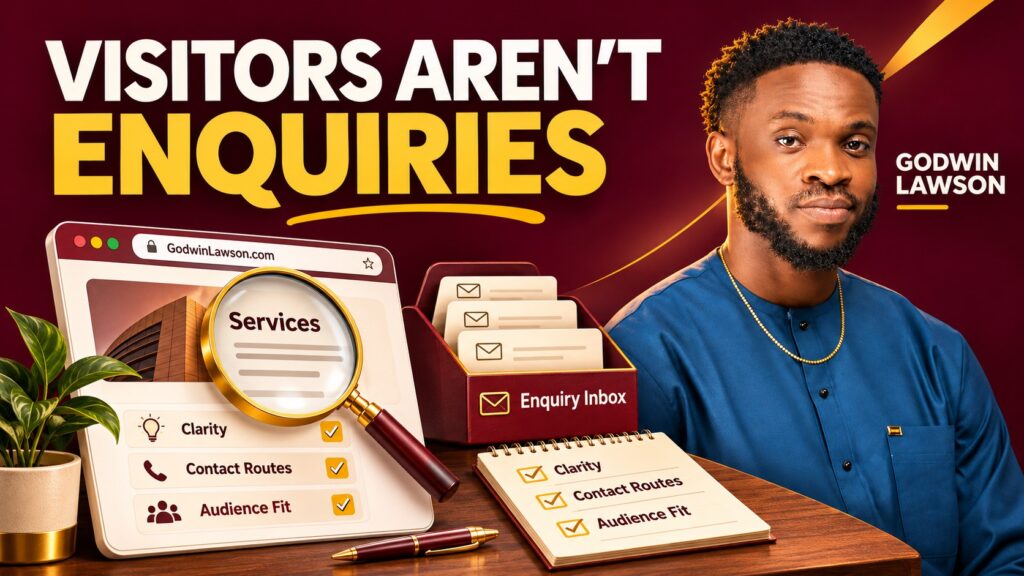
If your business website is not bringing enquiries, start by checking whether suitable customers are visiting, whether the pages explain your offer and whether interested people can contact you successfully. The problem may sit in one part of that journey or across several.
A visually polished website can still leave a buyer unsure what you do, where you operate, whether your experience is relevant or what happens after they make contact.
Before buying more advertising or replacing the website, use this checklist to gather evidence. It is designed for service businesses reviewing enquiry performance, rather than online shops reviewing completed checkout sales.
Separate a traffic problem from an enquiry problem
Look at the available information before deciding that the website has failed. A new site with little relevant traffic faces a different problem from an established site with regular service-page visits and few meaningful conversations.
| What you observe | What to investigate |
|---|---|
| Few suitable people reach service pages | Search visibility, referrals, campaign targeting and the content attracting visitors |
| Visitors reach relevant pages but rarely contact you | Offer clarity, evidence, suitability, usability and next-step instructions |
| Contact clicks occur but messages are scarce | Whether the contact route opens correctly and whether clicks become conversations |
| Enquiries arrive but few are suitable | How your pages describe audience, scope, location and commercial fit |
| Suitable enquiries arrive but stall | Response quality, qualification, proposals, timing and follow-up |
These are diagnostic directions, not proof of a cause. Low numbers, seasonality and several changes happening at once can make interpretation difficult.
1. Can a visitor explain your service after reading the page?
Give someone unfamiliar with the business a service page and ask three questions: what is being offered, who is it for and what should an interested person do next?
Replace vague claims with useful explanations. “We deliver innovative solutions” tells a buyer little about scope. A clear service description identifies the problem addressed, typical deliverables, working arrangements and the next step.
If you serve several sectors, organise them without forcing every buyer through every detail. A corporate procurement officer and a small business owner may need different levels of information.
2. Does each important service have a useful destination?
A long list of services on the homepage can provide an overview, but a buyer may need more detail on one service before making contact. Give that topic enough space to answer reasonable questions.
Explain what is included, who provides it, what the client needs to supply and any important scope limits. Where pricing depends on requirements, explain the main cost drivers and what information is needed for a quotation.
My own services page provides an overview of website development, digital systems, marketing and consultation. The relevant service section is the starting point for discussing a specific requirement.
A project example: presenting specialist capabilities
My BIUC Industrial Services website project, delivered through Techmita, connects company information, specialist service areas and contact routes. It offers a practical example of organising several capabilities for prospective clients.
The lesson is structural: let a visitor move from a broad company introduction to the relevant service and then to an appropriate enquiry. The case study does not provide conversion figures, so it should not be read as proof of a particular increase in leads.
3. Show evidence relevant to the buyer’s concern
Useful evidence helps someone assess your capability. A case study can explain the original need, your contribution, what was delivered and the limits of the available outcome information.
- Show work that relates to the service being discussed.
- Identify your role and any team contribution accurately.
- Use quotations and client materials only with appropriate permission.
- Explain measured results with dates, definitions and supporting records.
- Distinguish an intended benefit from a demonstrated result.
For example, a school website project can demonstrate experience with educational information. It does not automatically prove experience building every kind of private administration system. My selected work provides project-specific context.
4. Make the next step clear and manageable
Decide what an enquiry should accomplish. A short consultation request, a quotation brief and a support ticket are different processes. A button should tell the reader which one they are starting.
Ask for enough information to provide a useful reply. A service enquiry might need the organisation, requirement, timing and preferred response route. Requiring a lengthy specification before an initial conversation can be unnecessary.
A useful enquiry route gives the visitor a clear action and gives your team enough context to respond.
If you use WhatsApp, include a relevant opening message where helpful. If you use forms, explain receipt and the next step. Avoid promising a response time the business cannot consistently meet.
5. Test the contact route from beginning to end
With the website owner’s approval, test the form or enquiry route using clearly labelled test information. Confirm delivery to the right person, check error messages and verify that the acknowledgement describes what actually happened.
Review telephone links, email addresses and contact details on important pages. Check the route on a phone as well as a computer. Where an external booking or messaging service is involved, review that transition too.
A contact button click is an intermediate signal. It does not establish that a message was sent, read or qualified as a business opportunity.
6. Review mobile reading and page performance
Read a complete service page on a phone. Check menus, text size, contact buttons, forms and any elements that cover the content. Make sure a visitor can understand the offer before being asked to dismiss repeated interruptions.
Measure suspected loading problems and identify their causes. Large images, scripts or hosting constraints require different remedies. A slow impression from one visit is a reason to investigate, rather than enough evidence to prescribe a full rebuild.
My website care and technical support services cover reviews and fixes for existing sites; a new build is a separate scope decision.
7. Check the quality of the traffic you attract
Review the questions your content answers and the promises your adverts make. A broad informational article may attract readers who are not ready to hire. That can still be useful, but their next step may be a relevant guide rather than an immediate quotation request.
Keep campaign messages consistent with the destination page. If an advert offers one service in a particular location, the landing page should explain that service and location clearly.
For support with discovery and content planning, explore my SEO and local search positioning services.
8. Review what happens after a suitable enquiry arrives
Check whether the team acknowledges the request, answers the actual question and explains the next step. A technically sound website cannot resolve delayed responses or proposals that do not match the prospect’s requirement.
Record enquiry source where reasonably available and distinguish relevant enquiries from spam and duplicates. Review progress over comparable periods, accounting for campaigns and seasonal demand. Avoid attributing every change to the latest page edit.
Choose a focused first improvement
Write a short action list with the issue, supporting observation, proposed fix, owner and measure. Repair broken contact routes first. Then improve unclear service information and missing evidence. Use the findings to decide whether the site needs targeted work, a content project or a larger redesign.
I provide website design and development and focused consultations for organisations that want a practical starting point.
Frequently asked questions
Will more traffic solve low enquiry numbers?
It may help when suitable visitors are scarce. It will not automatically resolve unclear services, unsuitable targeting or broken contact routes.
Should I redesign before running adverts?
Review the intended landing page and contact process first. The work required may be a few focused improvements or a wider project, depending on the findings.
Can you guarantee a particular number of leads?
No. Agree the work and measurement approach, then assess results in the context of audience, demand, budget and the business’s response process.
Discuss your website with me
I am Lawson Godwin Hezekiah, founder of Mita School and Techmita. Tell me what your organisation needs to improve, who the website serves and what visitors should be able to do. We can agree the scope, priorities and next steps.
- WhatsApp: Send me a message on WhatsApp.
- Contact form: Send a project enquiry through my contact page.
- Email: [email protected].
- Phone: +234 703 799 7791.
Based in Uyo, Akwa Ibom State, Nigeria. Remote project arrangements can be discussed.