An About page should help a visitor understand who is behind the business, what you do and why your experience is relevant to their needs. Use specific facts and suitable evidence rather than broad claims of leadership or excellence.
Your story can contribute, but the reader still needs to understand the organisation as it operates today and how to take an appropriate next step.
Answer the visitor’s first questions
Begin with a plain description of the person or organisation, the work offered and the audience served. Add location or delivery arrangements where they affect the engagement.
A visitor should not have to read a long origin story before discovering whether you build websites, supply equipment or provide training. Give the current context first, then explain the relevant background.
Choose facts that support a decision
| Reader question | Useful content | Evidence to check |
|---|---|---|
| Who will do the work? | Roles and delivery arrangements | Accurate names and responsibilities |
| Have you handled relevant work? | Selected project examples | Approved case studies |
| What guides the business? | Principles shown through practice | Concrete behaviours or examples |
| How do we begin? | Suitable service and contact routes | Working links and monitored channels |
Use your story to explain your approach
An origin story is useful when it helps readers understand the way you work. A founder’s learning journey might explain why practical teaching or clear communication matters to the business.
Choose the details with that purpose in mind. You do not need to publish every personal event or turn private experiences into a marketing narrative. Share what you are comfortable making public and what helps the reader assess fit.
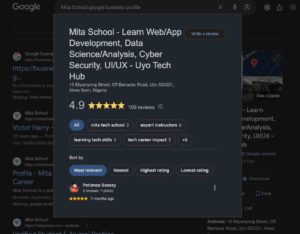
On my About page, my work with Mita School and Techmita provides context for the connection between technology, business and education. The page gives the background; individual project pages carry more specific work evidence.
Replace vague praise with supported descriptions
Instead of calling the business “the best digital company”, describe the types of work you deliver, the organisations you serve and how an engagement is handled. Where you make an outcome claim, retain the evidence and relevant period.
Years of experience should have a defensible basis. Memberships, certifications and partnerships should be current and accurately named. A one-time collaboration should not be presented as an unlimited institutional endorsement.
If work is delivered with a team, explain the arrangement rather than implying that one person performs every specialist task.
Connect claims to relevant projects
A short statement about experience can link to a documented example. My project portfolio gives readers a route from a broad professional introduction to specific website work.
A project description should state the role and deliverables accurately. A screenshot can illustrate an interface, but it does not establish revenue growth. Keep the About-page summary within the evidence available in the case study.
Approved testimonials can add a client’s perspective. Preserve their meaning and attribution, and confirm permission for the intended use.
A hypothetical rewrite
Imagine a small consultancy describing itself as “Nigeria’s number one transformation partner”. Without a defensible comparison, that statement asks readers to accept an unsupported ranking.
A more useful introduction could explain the services offered, the kinds of organisations served and the way projects are scoped. An approved project example could then show the work in detail.
This is a writing example, not a description or endorsement of a real consultancy. The goal is greater specificity, not a more elaborate slogan.
Show the people clearly and accurately
Use suitable photographs and current role descriptions. Do not present generated people or stock photographs as the actual team. If a business uses partners or freelancers, describe the delivery arrangement truthfully.
Give enough context for the reader to understand responsibility without exposing private contact details. Keep personal biography proportionate to the purpose of the page.
Review the wording when staff, ventures or services change. A carefully written page can become inaccurate if it is never maintained.
Make the next step relevant
Link to the services and evidence that support the introduction. A prospective client should be able to move from “Who are you?” to “Can you help with this requirement?” without searching the whole website.
My website writing support can help organise the story and source material. A wider positioning review can clarify the audience and offer before the page is drafted.
- State the current work and audience.
- Select relevant background.
- Verify professional claims.
- Link to specific evidence.
- Check photographs and permissions.
- Give readers a useful next action.
Frequently asked questions
Should the page use “I” or “we”?
Use the voice that accurately represents the business and who delivers the work. Keep it consistent with the rest of the site.
Must we include every achievement?
No. Select the experience that helps the intended reader understand your suitability. More detail can live in relevant project or news pages.
What if we are a new business?
Explain the current offer, relevant individual experience and delivery process honestly. Do not invent a company history or client list.
Discuss your next step
For help applying this to your organisation, share a short description of your situation and the decision you need to make.